Posted by Dana Whitfield
The Sleep Sanctuary

In this article
What is fill power? The space one ounce of down fills, in cubic inches. Higher means the same loft, lighter on you.
Cloud Heaven Duvet
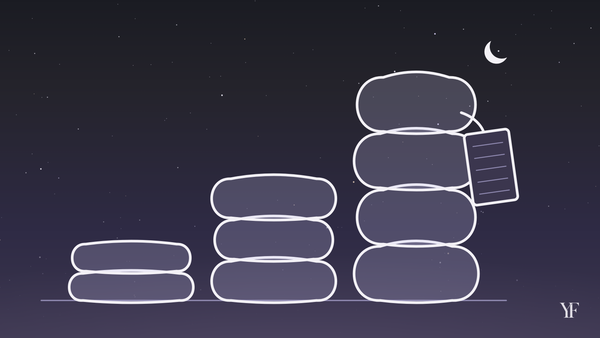
One ounce of 600 fill power down rises to 600 cubic inches in a lab cylinder. One ounce of 900 rises to 900. Same weight, half again the space. So a higher number buys lightness: the same tall, fluffy height with fewer ounces resting on you. How much down goes in, the fill weight, is a separate number. The two together set the warmth.
You have probably stared at 600, 800 and 900+ on three listings and wondered what the jump actually buys. Under one fill power video, a viewer pleaded for the numbers in ounces. So we worked out the ounces, then put each number in bed. We make duvets at the top two of those numbers: Cloud Heaven and Air in 800+ premium down, Royal in 900+ goose down. So we have an opinion. We will also say when a lower number is the smarter buy.
- 900 cu infilled by one ounce of 900 fill power down
- 1.5 ozof 600 fill down to fill that same space
- About 5%the test's own margin either way (IDFL)
- 800+Cloud Heaven and Air. Royal goes to 900+
Fill power vs fill weight: what is the difference?
Fill power is how much space each ounce fills. Fill weight is how many ounces are inside. A label needs both before it tells you anything about a duvet.
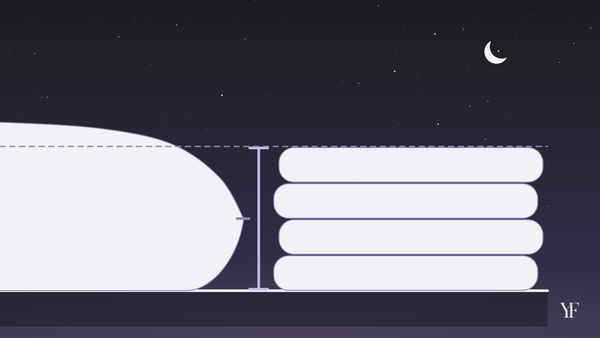
The drawing below fills the same space twice. 1.5 oz of 600 fill power down reaches the same height as 1 oz of 900+. Same loft, same look from across the room. One of them puts an extra half ounce on you for every ounce of the other, and across a whole duvet those half ounces add up.

This is where shoppers get tripped up: fill power gets described as how much down is in there. That is fill weight. A comforter can wear a proud 700 on its tag and still look thin, simply because there is not much of it.
Our Royal Goose Down Duvet is a clean example of reading both: 3.5 kg of 100% Canadian Hutterite white goose down at 900+ fill power. The kilograms are the fill weight. The 900+ is how much air each ounce of it holds.
One brand sells the same 700+ Queen at 16 to 39 oz: see how to choose the best down comforter.
Is higher fill power warmer?
Ounce for ounce, yes. For a whole duvet, only once you know how much down is inside and how big the duvet is.
IDFL publishes a warmth factor that puts the three together: fill power times net fill weight in grams, divided by the size in square centimetres. Run two duvets of the same size through it. 600 times 1,000 g is 600,000; 900 times 700 g is 630,000. Same area, so the 900 fill duvet comes out ahead while its down weighs 300 g less.
Flip it round and a heavy duvet of 600 fill can be every bit as warm as a light one of 900+. It just weighs more on you. That is the honest trade: fill power buys lightness, fill weight buys warmth. If what you want is warmth without the heavy feeling, our piece on a warm winter duvet without the weight goes deeper.
For a real warmth number on a whole duvet, look for a TOG. It is measured on the finished duvet, so it takes in the build as well as the down. Royal gives one for each of its two warmths: All Season, 12 TOG, for bedrooms around 60 to 67 °F (16 to 19 °C) and anyone who sleeps cold; Lightweight, 7.5 TOG, for bedrooms around 66 to 72 °F (19 to 22 °C) and down lovers who run warm. In between? Choose Lightweight.
What does fill power change when you are in bed?
It changes how much your warmth weighs. With high fill power the height comes from air, so a duvet can look tall and full while very little rests on your chest and shoulders. Lower fill power can reach the same height, but only by adding ounces, and you feel those when you turn over.
There is a catch the labels never mention: down can only rise if the shell gives it room. Small stitched squares hold the top and bottom fabric together at every seam, so even very good down sits in low puffs between them. That is one reason a comforter with a big number can still look flat on the bed.

In our patented Cloud Shell, wide chambers inside a framed edge take the place of the small stitched squares on an ordinary comforter, so the down has room to rise. The frame is split at the head, foot and sides, so the down stays even and each sleeper keeps a full share. All three of our duvets are made this way. Here is what that room does with the down in each:
- Cloud Heaven Duvet. Our signature, and the airiest duvet we make: 3.5 kg of 100% Canadian premium down at 800+ fill power. That is a lot of high grade down with room to rise, so you get the tall, full look with barely any weight on top of you. Give it a shake when you make the bed and the down lifts right back up.
- PureFlow Air Duvet. The same 800+ premium down as Heaven, in a lighter 1.75 kg fill. Light as air, with a soft, relaxed drape. Made for warm sleepers, warm rooms and summer, for nights when you want less warmth.
- Royal Goose Down Duvet. The step up. Our rarest, most limited down and our highest fill power: 100% Canadian Hutterite white goose down at 900+ to pull around you, in All Season or Lightweight.
Choosing between the three? Our guide to Air, Heaven or Royal lines them up. And if you love the heavy, pressed feel of a thick comforter, or want the most warmth for the fewest dollars, more down at 600 or 650 fill does that honestly. It weighs more on you, and for some sleepers that is exactly the point.
How is down fill power measured?
A lab weighs out a sample of down, lets it relax, and reads how much space it holds up in a clear cylinder. At IDFL, one of the labs that tests down, the sample is 30 g, about an ounce. It is conditioned first (IDFL finds steam the most consistent way), and about 72 hours at 68 °F (20 °C) and 65% humidity normally lets it reach its full loft.
Then the down goes into the cylinder, a light weighted disc settles on top, and the height it holds up is read off and given as cubic inches per ounce (Buffalo Jackson walks through the steps). That is the whole test. No warmth, no softness, no bird. Just space per ounce.
The part almost nobody prints: the test wobbles. IDFL counts any result as possibly 5% either way of a shipment's real fill power, and a 1 to 2% difference between cylinders can move the number by 8 to 16 points. So a label is a good guide, not a laser. 600 against 900 is a real difference. 850 against 900 sits close to the noise.
Down vs feather, goose vs duck: do they change the number?
Feathers pull the number down. The bird matters less than the number on the label.
A feather has a stiff quill down the middle and flat vanes on either side. A down cluster has no quill at all, just a tiny centre with fine filaments that hold air in every direction. That shape is why down lofts and feathers mostly lie flat, and why IDFL notes that a sample with more feathers tests at a slightly lower fill power. It is also why feather blends poke: the quill is the part that finds its way through fabric.


Labels often give a ratio like 90/10. The first number is the share of down clusters, the second the rest, mostly feathers (Constant Mountain explains the ratios). The higher the first number, the more of the fill is doing the lofting.
Goose or duck? Goose clusters tend to run larger than duck (Field Mag). But fill power is measured on the down itself, so two labels with the same number loft the same in the test, whichever bird it came from. Compare the number, not the bird.
For the record: Heaven and Air are 100% Canadian premium down at 800+ fill power. Royal is 100% Canadian Hutterite white goose down at 900+, 97% down cluster and 3% down fiber, with no feathers, and never duck. In all three: no feather crunch, no smell. Pillows follow the same two grades: the Cloud Pillow, from $199.99 USD, holds the same 800+ down as Heaven and Air, and the Royal Goose Down Pillow the same 900+ goose down as Royal. For the full feather and down alternative comparison, read our guide to down vs down alternative comforters.
600 vs 800 vs 900 fill power: is the jump worth it?
From 600 to 800, yes. From 800 to 900, yes, if you want even more loft from every ounce. From 850 to 900, not on the number alone.
Every row in the chart is one sum: 900 divided by the fill power gives the ounces needed to match one ounce of 900+. From 600 to 800, each ounce fills a third more space: height you can see, weight you can feel come off. From 800 to 900 is another eighth, real but smaller, and more than twice the test's margin, so it is a step you can count on. From 850 to 900 is about 6%, close to the test's own 5% margin, so do not pay much extra for those 50 points alone.
Fill power chart, 500 to 900+: what one ounce fills, and the down it takes to match 1 oz (100 g) of 900+
| Fill power | 1 oz fills (100 g fills) |
To match 900+ |
|---|---|---|
| 500 | 500 cu in (28.9 L) |
1.80 oz (180 g) |
| 550 | 550 cu in (31.8 L) |
1.64 oz (164 g) |
| 600 | 600 cu in (34.7 L) |
1.50 oz (150 g) |
| 650 | 650 cu in (37.6 L) |
1.38 oz (138 g) |
| 700 | 700 cu in (40.5 L) |
1.29 oz (129 g) |
| 750 | 750 cu in (43.4 L) |
1.20 oz (120 g) |
| 800 | 800 cu in (46.2 L) |
1.13 oz (113 g) |
| 850 | 850 cu in (49.1 L) |
1.06 oz (106 g) |
| 900+ | 900+ cu in (52.0+ L) |
1.00 oz (100 g) |
Figures in brackets are per 100 g, not conversions of the ounce figures: 100 g of 600 fill fills 34.7 litres, and 150 g of it matches 100 g of 900+.
Is there a point where higher stops mattering? ProLiteGear argue that the returns shrink past 900 and that the very highest numbers are touchy about humidity. That is their view from working with jacket down, and it fits the arithmetic: each step of 50 adds a smaller share than the one before.
Our take for a duvet you sleep under every night: the light, tall feel shows clearly from about 800. That is where Cloud Heaven and Air sit, and with 3.5 kg of 800+ inside, Heaven is a big, airy bed you sink into. 900+ is the step up: an eighth more space from every ounce, in rarer goose down. That is Royal. If a label says 850 and the price is kinder, that is a fair buy too. Check the fill weight and the build first, and see what makes a luxury duvet worth it for the rest of the list.
Free tool
Fill power visualiser
Slide to the number on your label. Space in the test cylinder, not a warmth rating.
600 cu in
One ounce of 600 fill power down fills 600 cubic inches in the test cylinder. It takes 1.5 oz of it to fill the space of 1 oz of 900+.
900+ fills 50% more space per ounce than 600.
Your label, 30 oz of 600, fills about 18,000 cubic inches. 900+ down fills that space with 20 oz.
- Every step from 500 to 900+ is in the fill power chart above.
- Your label: fill power times fill weight in ounces gives the cubic inches it fills. Divide by 900 for the ounces of 900+ that fill the same space.
- Ours: Cloud Heaven, PureFlow Air and the Cloud Pillow are 800+. Royal is 900+, our highest.
"It really comes down to how much of a factor weight is."
Questions people ask
What is a good fill power for a duvet?
Our view: 600 to 700 is good everyday down, and from about 800 you get real height without much weight. Our Cloud Heaven and Air duvets are 800+, and Royal is 900+, our highest. Whatever the number, read the fill weight and the build next, because good down in a thin or tightly stitched duvet still looks flat.
How warm is 800 fill down?
Warmer than 600 ounce for ounce, but the number alone cannot tell you how warm a duvet is. 30 oz of 800 fill fills the same space as 40 oz of 600: 24,000 cubic inches each on the test bench. Look for the fill weight, or a TOG, before you judge warmth. 800+ is the down in our Cloud Heaven Duvet, 3.5 kg of it.
What is 650 fill power down?
Down where one ounce fills 650 cubic inches in the test. It takes 1.38 oz of it to fill the space of 1 oz of 900+. Good everyday down: you get the loft with a little more weight on you.
Does 550 or 650 fill down have a temperature rating?
No. 550, 650 or 900, the number is cubic inches per ounce, a measure of loft in a lab cylinder. It is not degrees and not a TOG. Warmth depends on that loft, how much down there is and how big the duvet is.
Which is warmer: 80 g of 800 fill or 100 g of 750?
Multiply fill power by weight. 80 g of 800 fills about 2,260 cubic inches; 100 g of 750 fills about 2,650. The heavier, lower number fills about 17% more space, so at the same size it is the warmer one, and also the heavier one.
Does down alternative have a fill power?
Not on the same scale. Fill power is a test for down and feathers, and synthetic fills are not rated that way (Field Mag). If a down alternative comforter quotes a fill power, ask which test it means.
Can you wash a down duvet at home?
Ours, yes: every YumeFeel duvet is machine washable. Wash it only when it needs it, cold on a gentle cycle with a mild down wash and an extra rinse, then dry on low with clean dryer balls until completely dry. Skip bleach, fabric softener and high heat. Follow the item label, and if the duvet crowds your machine, use a suitable larger washer and dryer. The full steps are in our duvet care guide.
Why do some down comforters poke?
Usually it is feather quills working through the fabric. Down clusters have no quill. Every YumeFeel duvet is premium down: no feather crunch, no smell.
How we worked it out: fill power is cubic inches per ounce of down, so every number in the chart, the drawings and the tool is that definition multiplied or divided. 1 cubic inch is 16.387 cubic centimetres; 1 ounce is 28.35 g. Test conditions, the 5% margin and the warmth factor are IDFL's (tolerance and warmth factor pages, read 13 Nov 2026). YumeFeel details: our own listings and pages, 13 Nov 2026.
Also read: Buffalo Jackson (cylinder and disc), Constant Mountain (fill ratios), Field Mag (goose clusters, synthetics), and the videos credited above.
Loved by thousands of dreamers
Airy at 800+. Rarest at 900+.
Each duvet comes with a PureFlow Duvet Cover, free for a limited time.


PureFlow Air Duvet
A lighter layer to curl into, for nights when you want less warmth.
$889 From $529 USD

Royal Goose Down Duvet
Soft, lofty goose down to pull around you. Choose the warmth you love.
$2,220 From $1,720 USD