Posted by Morgan Ellis
The Sleep Sanctuary

In this article
If you fall asleep comfortably and wake up pushing the duvet away, start with less insulation. A cover that feels cool at first touch cannot turn a warm insert into a light summer layer.
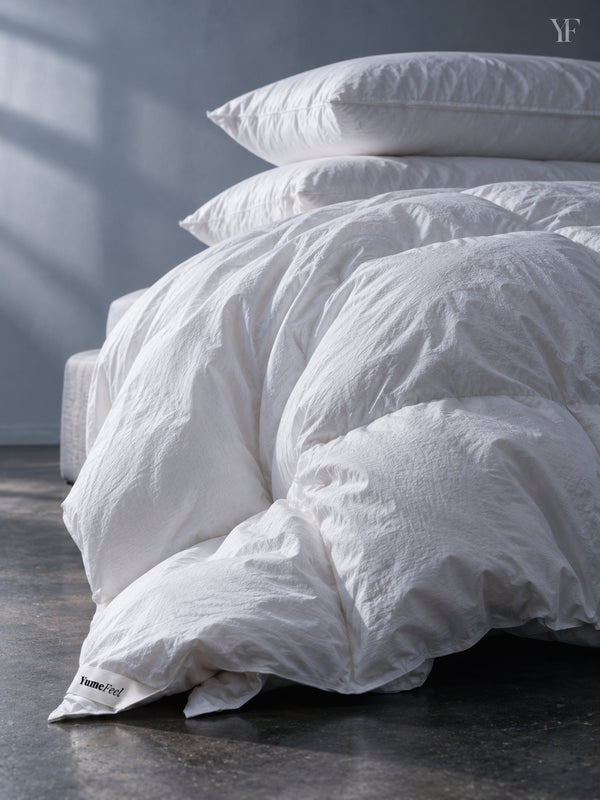
For hot sleepers choosing YumeFeel, PureFlow Air Duvet is the first option to consider. It is 1.75 kg of 100% Canadian down, light as air, in a breathable PureFlow 300T shell that is soft and cool to the touch. If you want the best down comforter for hot sleepers from our range, start here. You can still make a beautiful bed without choosing the fullest duvet in the photograph.
Find out which part of your bed feels too warm
Before buying anything, try removing the throw or spare blanket you leave across the bed. If that is enough, keep the duvet you like. If you still kick the filled layer away, the insert itself may be more insulating than you want. Change one layer at a time so you know what helped.

Think about the room you actually sleep in. A heated apartment in January can call for lighter bedding than a cool coastal bedroom in July. Your country and the season are clues, not a complete buying rule. In Australia, where this filled layer may be called a quilt or doona, the same practical check applies.
| Your experience | A useful first change | What to check next |
|---|---|---|
| Warm under the whole duvet | Try a lower warmth rating | Remove extra blankets before judging the change |
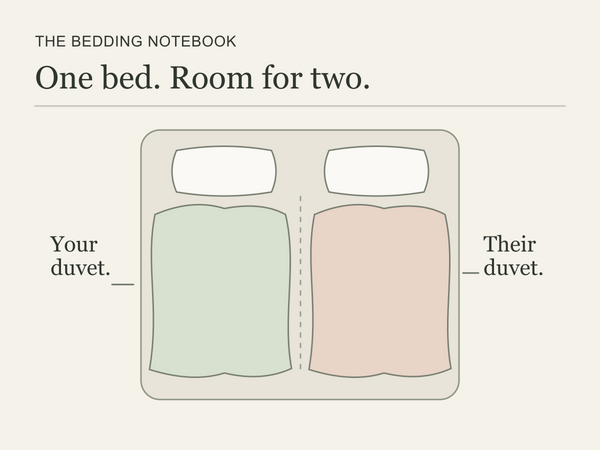
| One person is comfortable; the other is too hot | Discuss separate warmth preferences | A shared duvet may be a compromise; separate layers can help |
| Comfortable at bedtime, too warm later | Judge the whole night, not first-touch coolness | Look at the insert and the room, not just the cover |
| Warm only beneath a heavy throw | Take that layer off for sleeping | You may not need a new duvet at all |
Read TOG as a warmth guide
TOG describes thermal resistance. Textile testing laboratory IDFL explains why a flat laboratory result cannot predict every sleeper's experience: how bedding fits around you matters too. Use the number to compare warmth, then judge your room and preferences.
In our range, every duvet is premium down and the difference is how much sits inside. Air is light as air, Heaven is 3.5 kg of the airiest down and our signature fluffy duvet, and Royal is our rarest down in Lightweight or All Season. Heaven's plush shape is appealing, but it would not be our first recommendation for someone whose main complaint is overheating.
Ask what a cooling claim actually measures
A cold-feeling surface, moisture-handling claim and lower-insulation duvet are different promises. If a product mainly advertises “cooling,” ask which of those it means and whether evidence covers the whole filled duvet or just a sample of fabric.
| The listing tells you | Still ask |
|---|---|
| “Cool to the touch” | Does this describe the initial surface sensation or sustained whole-duvet performance? |
| “Lightweight” | Is that low warmth, low fill mass or low finished weight? |
| A low TOG rating | Which exact model and warmth option was measured? |
| A breathable fibre | What are the cover, filling quantity and construction of this actual product? |
For Air, the useful facts are its 1.75 kg of 100% Canadian down, light as air and its PureFlow 300T shell, a custom cotton blend that is breathable and cool to the touch. Those make it our cooling duvet insert and our lower warmth starting point. We do not have a measured head-to-head cooling result that would justify calling it colder than every competing duvet.
Choose a cover you enjoy touching
A removable PureFlow cover, our custom cotton blend, is breathable and cool to the touch, and can be washed separately. For a limited time, PureFlow Duvet Cover is free with Air. That makes the two pieces straightforward to fit, but neither cotton nor a light fill is a promise that you will never feel hot.
Keep the rest of the bed in the decision. If you are comparing two inserts while also changing sheets, sleepwear and the room temperature, it becomes difficult to tell which change made the difference. Your most useful comparison is the same bedroom with one bedding change.

A full-looking bed without extra overnight layers
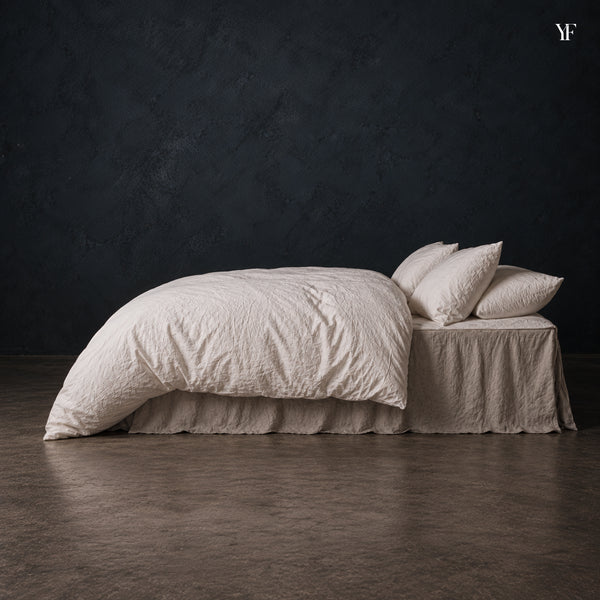
Build the finished look with shape and texture before adding another warm layer. Start with a cover you enjoy against your skin, straighten the insert inside it and let both side edges fall naturally. Fold the top back once so the bed has a clear, generous edge. Stand the sleeping pillows upright and keep any decorative cushion easy to remove. A woven throw can sit loosely across the foot for daytime texture, then move to a chair at night.
Look at the bed from the doorway: does the cover balance the width of the headboard, and does its colour connect with something already in the room? Those choices make a lighter duvet look intentional. For the bed measurements behind that outline, use the duvet size guide rather than adding a second insert for height.
Avoid stuffing two inserts into one cover just to imitate a photograph. You add warmth and weight, make laundering harder and may lose the easy drape you wanted. A lighter duvet can look deliberate when its proportions and colours work together.
Make the first few nights a useful comparison
Follow the seller’s trial and return conditions before using or washing a new item. When you are ready to judge comfort, keep the room setup and other bedding as consistent as practical. Change the insert or remove an extra layer, then note what you actually felt.
- At bedtime: was the whole bed comfortable, or only the first touch of the cover?
- When you woke: were you still under the duvet, had you pushed it aside, or did you want another layer?
- For a shared bed: did the other person want the same change?
This is a personal decision note, not a controlled test. If one person remains cold while the other pushes the duvet away, separate top layers may give both people a better choice than repeatedly buying a different shared duvet.
Check practical ownership too. Air’s care follows our down routine: keep it in its cover, wash only when needed on a gentle cycle with a mild down wash and an extra rinse, then tumble dry low until completely dry, with the care label and appliance capacity taking priority. “Lighter” does not mean a large duvet fits every washer or finishes drying on a fixed timetable.
Choose Air when this sounds like your bed
You want a lightweight down comforter, you prefer a lighter layer, and your priority is less warmth rather than maximum height. The PureFlow Air Duvet includes one filled duvet and one matching cover. It does not include the pillows or sheets shown in room photography.

If you are still deciding between the three fills and feels, compare Air, Heaven and Royal. Start with the night you want to have, then choose how to dress the bed around it.