Posted by Linden Shaw
The Sleep Sanctuary

In this article
A flat comforter can mean compressed filling, unfinished drying, a cover that has shifted or genuine wear. Start by finding which problem you have. Repeatedly putting it through the dryer is not a diagnosis.
Take off the cover and inspect the insert first. Lay it out in good light, check the seams and feel across the surface. This small step separates a duvet problem from an outer cover that is too large, twisted or no longer attached at the corners.
Follow the change, then choose the fix
Just unpacked or taken from storage?
Evenly compressed, with no dampness or damage → open it out and allow the filling to settle.
Evenly compressed, with no dampness or damage → open it out and allow the filling to settle.
Flat or clumped after washing?
Check the middle of the filling → follow the label’s drying routine until the whole insert is dry.
Check the middle of the filling → follow the label’s drying routine until the whole insert is dry.
Only empty at the cover’s edges?
Compare the uncovered insert with the covered bed → check dimensions and ties.
Compare the uncovered insert with the covered bed → check dimensions and ties.
Leaking, torn or persistently uneven?
Photograph it and contact the maker → care cannot repair failed seams or replace lost filling.
Photograph it and contact the maker → care cannot repair failed seams or replace lost filling.
Compare your duvet with itself
For a dry, intact insert, take one clear photo laid flat without its cover before the reset. After the approved care, lay it in the same direction and photograph it from the same position. Compare the area that bothered you, rather than making a new fold look thicker for the second picture.
That distinction matters when borrowing a styling tip. In Dianne Decor’s fluffy-bed demonstration, one method uses two inserts inside a cover. It changes the bed’s arrangement; it does not show lost loft returning to one duvet. If yours is damp or damaged, follow the checks below before trying to judge its finished appearance.
For compression, give the duvet space
Remove the packaging and spread the duvet across the bed. Lift it gently from two corners, let it settle, then repeat from another edge. The aim is to let the filling open, not pull hard against the stitching. Keep heavy blankets and luggage off it while it recovers.
A newly unpacked YumeFeel Cloud Heaven Duvet can take 24 to 48 hours for its premium down to open fully; the patented Cloud Shell gives the down room to rise. Judge it after that period rather than against the shape it held in the box. If your product label permits a low tumble to refresh it, use a suitable machine with room for movement.
Compression is also relevant to down. IDFL's fill-power guidance explains that packing and handling can reduce measured loft, and that suitable care can help it recover. That does not mean steaming your duvet at home; laboratory conditioning is a different process.
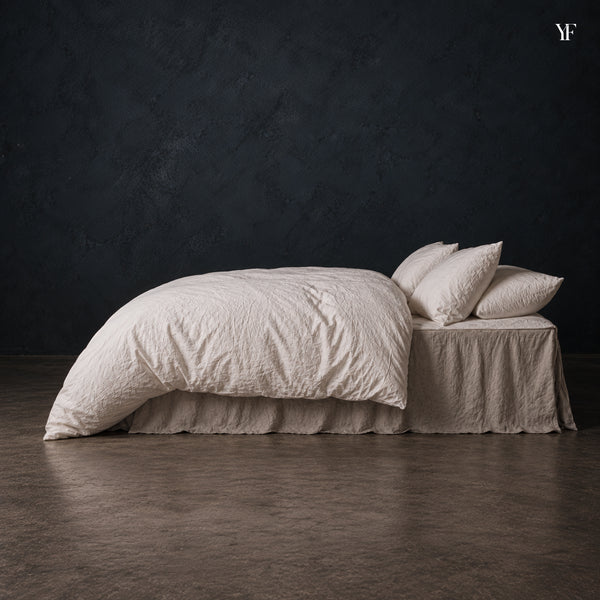
Lift and settle the duvet gently when making the bed. The opening image illustrates the movement, not a before-and-after performance test.
After washing, check more than the surface
The shell may feel dry while dense areas of filling still need time. Follow the care label, stop the machine when appropriate and check the centre, corners and thicker patches. Gently loosen soft clumps and reposition the duvet before continuing the approved drying cycle.

Do not force a bulky duvet into a drum where it cannot tumble. Whirlpool's care guidance calls for movement, repositioning and complete drying before use or storage. Use your duvet's own temperature and detergent instructions. For a YumeFeel down duvet, follow the care label: gentle cycle, mild down wash and an extra rinse, then tumble dry low until completely dry.
Do not add more detergent or fabric softener in the hope of creating fluff. YumeFeel's instructions exclude fabric softener. If the problem appeared immediately after washing, our clumping guide is the more focused next step.
If the insert looks fine, fix the cover
Measure the width and length of both pieces. A large empty border can come from a cover that does not match the insert. Replacing healthy filling will not solve that. Check the maker's intended fit rather than applying a universal rule about buying one size larger.

With a YumeFeel cover, connect all four corner ties and four edge midpoint ties to the duvet's loops. Settle the insert into the corners before closing the zipper. The ties keep it aligned; they do not add filling or restore worn material.

Give the reset a useful finish line
Once the insert is fully dry and you have completed the care its label permits, choose the result that actually describes it. A more dramatic bed photograph is not the only useful outcome.
The insert recovered
It lies more evenly, has no damage and feels comfortable again. Refit the compatible cover and return to normal care. More cycles are not automatically better.
The insert was fine
The empty corner or twisted shape returns only inside the cover. Use the cover-movement checklist instead of treating the filling again.
The problem remains
Hard clumps, bare patches, escaping fill or an opening seam remain. Stop repeating the treatment and ask the maker to assess the insert.
A care note you can save or send
- Item: Product, size and filling.
- Change: What looks different, where, and when it started.
- Care: The wash or refresh setting, detergent and drying steps actually used. If you are unsure, say so.
- Result: Recovered, cover-only problem, or still unresolved.
- Photos: The whole uncovered insert, a close view of the affected area and the care label.
Send this note with your photos so the maker can understand what changed and suggest the next step.
Know when to stop
Split seams, persistent bare sections and escaping fill need a different response. Photograph the uncovered duvet, its label and the affected area. Send those with the order details and a short care history to the maker before attempting repeated washes or repairs that might complicate support.
Heaven and PureFlow Air Duvet have the 5 year Loft Promise for covered flattening, clumping and fill drift, with restoration, refilling or replacement under its terms. Royal Goose Down Duvet has a separate 5-year warranty. Check the applicable coverage before buying another duvet. Use the repair-or-replace checklist if you are deciding whether the condition of the insert justifies replacing it.
If your duvet is healthy but has always been less full than you want, fluffing cannot turn it into a different construction. That is a preference decision. Compare loft, warmth and weight so the next choice solves the right problem. If height is what you miss, see the Cloud Heaven Duvet, 3.5 kg of the airiest 100% Canadian down in our patented Cloud Shell and our signature big, fluffy, oversized duvet.