Posted by Robin Lane
The Sleep Sanctuary

In this article
You find a bed you love, open the product page and discover that “set” might mean an empty cover and two pillowcases. The full, inviting part of the photo may still be a separate purchase.
Choose a duvet with a removable cover if you want to change the outer fabric while keeping the filled insert. Choose a finished comforter if you want to put one piece straight on the bed. Then check what the particular product includes. The names overlap, and neither one guarantees warmth, quality or an easier life.
Our recommendation is to start with the pieces you already like. There is little sense replacing a comfortable filled layer just to make its name match a shopping guide.
First, identify the filled piece
A duvet insert holds its filling inside its own shell. An empty cover goes around that insert and comes off separately. A comforter is usually a filled piece with an outer fabric intended to stay visible. Removing a duvet cover does not leave loose filling on the bed.

The boundary is not rigid. Brooklinen calls its products comforters, yet recommends a duvet cover for some of them and explains how the insert’s loops secure it inside. Its One Fluff and Done range is described separately as needing no cover. Read the instructions for the version you want.
That distinction is more useful than arguing over vocabulary: will you use this filled piece uncovered, or inside another layer?
Three sets that put different things in the box
Here is a comparison of current included-item lists, not a product ranking or a hands-on test. The IKEA examples are specific US listings; check the listing for your own country before buying.
IKEA NATTJASMIN duvet cover and pillowcases
Full/Queen, light beige
Inside: One empty cover and two empty pillowcases.
Still needed: A compatible filled insert and pillows, if you do not already own them.
IKEA LUKTJASMIN comforter set
Full/Queen, dark grey
Inside: One filled comforter and two pillow shams.
Still needed: Pillows for the empty shams. The comforter provides the filled top layer.
YumeFeel Cloud Heaven Duvet
Choose Queen, King or Cal King
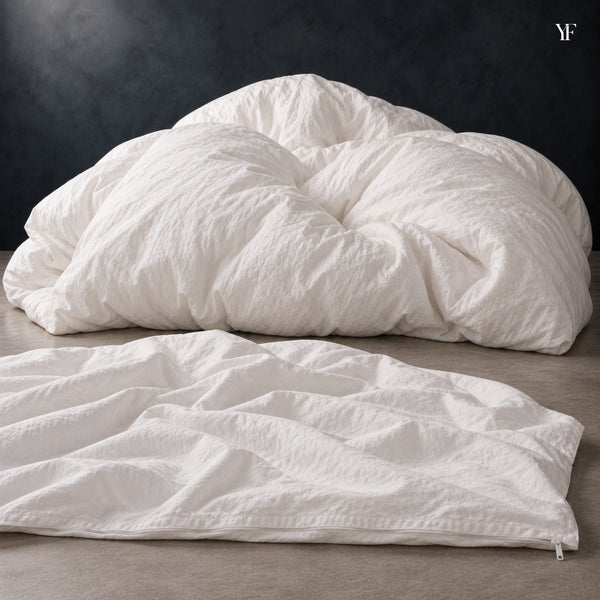
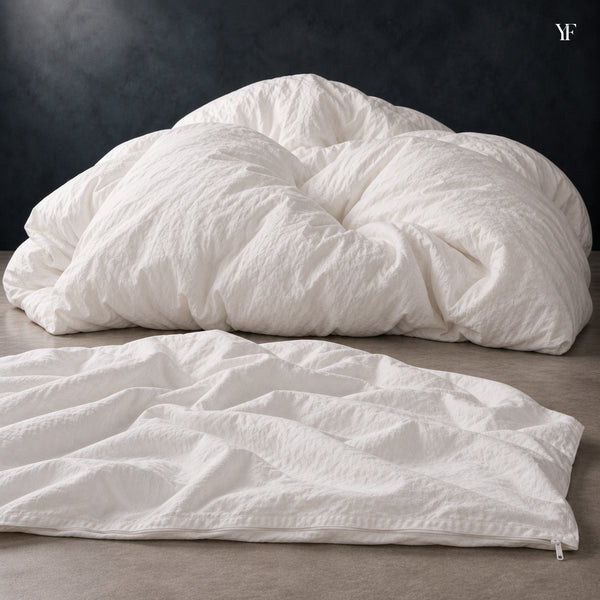
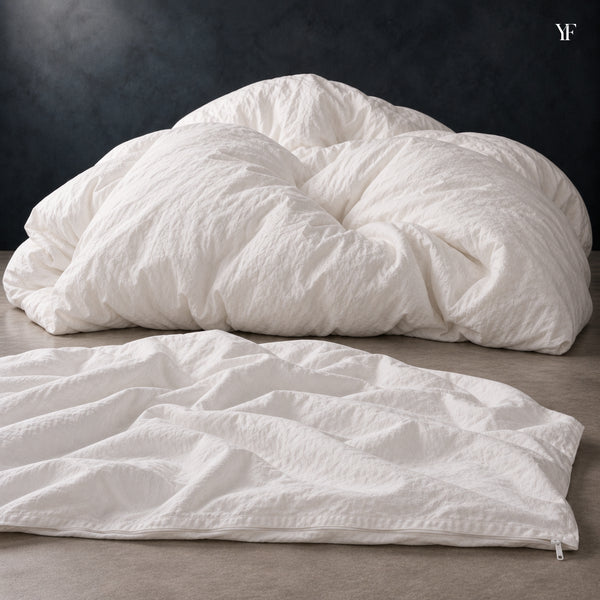
Inside: One Heaven premium down duvet in the patented Cloud Shell and one matching empty PureFlow cover.
Still needed: Use your own pillows, pillowcases and sheets, or choose them separately.
A pillow sham is not a filled pillow. A duvet cover is not a filled duvet. Those two checks prevent a surprising amount of confusion when a photograph shows a complete bed.
If you already own a cover, let it lead
Find its width and length, then check the intended insert size. “Queen” alone is not enough. In the listings above, IKEA’s NATTJASMIN Full/Queen cover is 86 × 86 inches, while the LUKTJASMIN Full/Queen comforter is 90 × 92 inches. Those products are not being offered here as a matched pair.
YumeFeel’s Heaven Queen insert and PureFlow Duvet Cover are both listed at 245 × 250 cm, approximately 96 × 98 inches. The smaller IKEA cover is not the size YumeFeel specifies for that insert. This is a compatibility check, not an argument that a larger duvet is automatically better.
Check attachment points too. Ties inside a cover need corresponding loops on the filled piece if you want to secure it that way. YumeFeel’s current cover has eight ties: four corners and four edge midpoints. A different brand may use another arrangement. Fastenings help alignment; they do not fix an unsuitable size.
Start with the manufacturer’s intended pairing before trying a tighter fit for a fuller appearance. Our duvet size guide handles the bed measurements and coverage decision in more detail.
Choose the amount of assembly you will actually tolerate
A cover gives you another fabric to choose and another piece to fit. That can be a pleasure when you like changing the room. It can also be the chore you keep putting off.
If fitting a large cover is already frustrating, take that seriously. A finished comforter you enjoy using is a sensible choice. If you prefer a covered insert, inspect the opening, closure and attachment instructions before ordering. A matching size solves one problem; it does not make the fitting step disappear.

The benefit of a removable cover is control over the visible surface. You can keep a filled insert that suits you and choose a different outer fabric when the room changes, provided the new cover fits.
Choose the texture you want to live with. If a comforter’s fuzzy or patterned outer fabric is the reason you love it, using it uncovered keeps that feature visible and touchable. If you want the fullness underneath with a different surface or a calmer colour, a compatible removable cover lets you separate those choices. The insert creates the body of the bed; its outermost fabric sets much of what you see and feel.
For a room refresh, try a folded pillowcase or other fabric you already own beside the headboard and wall before replacing the filled layer. Look in daylight and lamplight. That small check can show whether the change you want is colour, texture or actual fullness, and which purchase would make it.

Compare a ready-to-use setup, not two headline prices
An empty cover can appear cheaper than a comforter because it contains no filled top layer. An insert sold on its own may need a cover you have not priced yet. A set can include useful pieces, or charge you for extras you already own.
Your setup cost
Filled piece + a cover if required and not included + only the extras you are missing + destination charges.
For a limited time, PureFlow Duvet Cover is free with Cloud Heaven Duvet and PureFlow Air Duvet. Add a second cover if you would like a spare for wash day or a fresh colour. If you already have a compatible cover you love, compare an insert-only option from another listing on its actual merits. Our set versus separate guide takes that decision further.
Use your delivery country when comparing totals. YumeFeel currently ships free to the US and Canada; UK and Australia shipping is $50 USD.
Warmth is a separate decision
“Duvet” does not mean warmer, and “comforter” does not mean flatter. Read the actual fill, construction and warmth information. Within YumeFeel, Air is 1.75 kg of 100% Canadian down, light as air, and Heaven holds 3.5 kg of the airiest down. Both use removable covers, but they serve different warmth preferences.
TOG describes thermal resistance, not the finished weight in your hands. If you like a full-looking bed but sleep warm, decide how much warmth you want before chasing the tallest photograph. See the loft, warmth and weight guide for those separate choices.
Save this check before you buy
- Filled piece: Is one included, or is this only a cover?
- Outer layer: Is a separate cover recommended, and do I already have the right one?
- Fit: What are both dimensions, and does the manufacturer recommend this pairing?
- Setup: Can I manage the closure and attachment method comfortably?
- Actual gap: Which included pieces do I need, and what is still missing?
- Total: What will this usable setup cost for my delivery destination?
Then read the care labels for the filled piece and any separate cover. If washing and drying are what will decide it, our sister journal YumeRest has the practical laundry-routine comparison, including what needs to fit your machine and what goes back on the bed while another layer dries.
The easiest option is the one that fits your existing pieces and the way you use your bed. Buy a matched covered set when you need both layers. Keep a good cover when a compatible insert is enough. Choose a finished comforter when the simpler setup is the feature you want most.
Product-list comparison checked 1 October 2026. Retailer listings are linked for their own contents and measurements. This is YumeFeel’s buying advice, not an independent product test; other brands’ stock, specifications and regional listings can change.