Posted by Taylor Arden
The Sleep Sanctuary

In this article
If you already like your comforter, a cover can be a smaller change than replacing it. It is worth adding when you want a different surface or colour, or a removable layer for routine washing. It is optional, and it will not make an overly warm comforter cooler.
The best starting point is the comforter on your bed, not a new bundle. Keep its good qualities. Check whether a cover would solve the particular thing that bothers you.
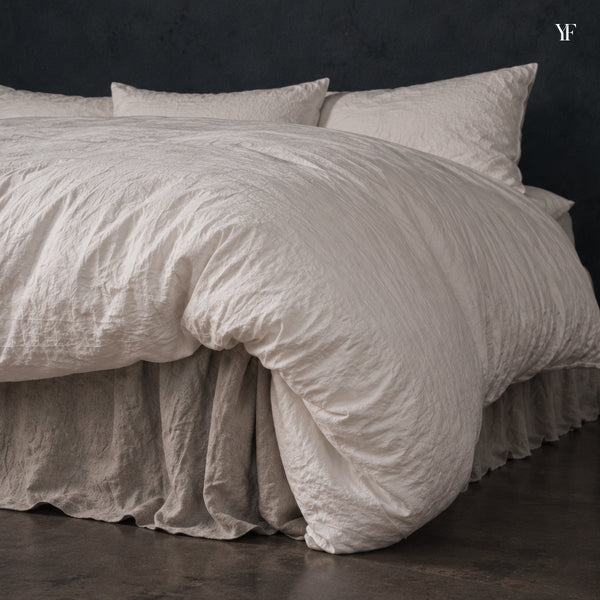
Use a cover to change the part you see and touch
Think of the cover as the largest fabric choice in the bedroom. If you like the comforter’s warmth and fullness, a different outer surface can let you keep that comfort while changing the room. Decide first whether you want the bedding to be a calm background for a distinctive headboard or the main colour in a simpler space.
Use a pillowcase or fabric you already own to try a colour beside the wall, headboard and curtains, in daylight and with the bedside lamps on. Then choose the cover’s surface for the way you like to sleep: smooth woven cotton is a different sensation from a fuzzy comforter shell. Covering the fuzzy surface changes the part you touch, even though the filling underneath stays the same.

Match the fix to the complaint
| What bothers you | What a cover offers | What stays the same |
|---|---|---|
| I like the comforter, but not its colour or surface | A different visible fabric around it | The existing filling and most of the bulk remain. A plush surface will be enclosed. |
| Washing the whole comforter is cumbersome | A removable layer for more frequent surface washing | The comforter still needs cleaning when soiled or required by its label. |
| I feel too warm or weighed down | No dependable fix for that problem | You are adding fabric, not removing insulation or filling. |
| It looks flat or has damaged filling | A new colour may refresh the look | An empty cover does not restore lost fill or repair damaged construction. |
First, check the comforter you want to keep
Look at its label, dimensions and edges. Some comforters are designed to work either on their own or inside a cover. For example, The Company Store’s Classic Down Alternative Comforter has corner loops and is explicitly listed for both uses. That is more useful evidence than assuming every item sold as a comforter works the same way. For the difference between a covered insert and a finished comforter, see our duvet-versus-comforter guide.
A comforter without loops is not automatically unusable inside a cover, but there may be no matching attachment points to hold it in position. Expect that you may need to reposition it. Ask the maker before modifying its shell or adding fasteners; the shell is the part containing the fill.

Do the fit check before ordering a colour
- Lay the comforter flat and measure width × length. Measure its main body, excluding decorative flanges. Keep the measurement units consistent.
- Read the proposed cover’s actual dimensions. King and Queen names vary between products and markets. Ask about the intended pairing if the measurements differ.
- Check attachments and closure. Count where the cover’s ties and comforter’s loops correspond. A longer list of ties does not create loops on a comforter that has none.

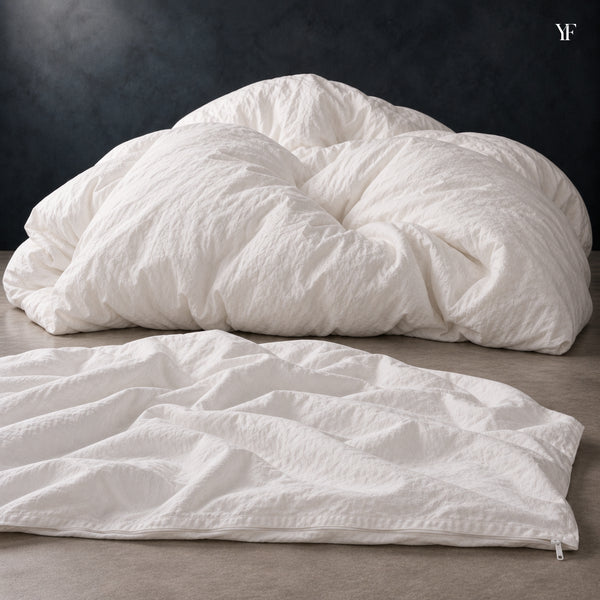
When the cover arrives, align the corners and lay the pair flat before judging it on the bed. Close the zipper without pulling it against a forced lump of filling. If one edge is empty while another is crowded, check orientation and untangle the insert first. Persistent excess fabric or bunching can be a size mismatch, not a reason to pull the ties tighter.
Read the seller’s return conditions before washing a newly purchased cover. For a cover you already own, use its present measurements after normal care rather than assuming an old label still describes the usable pocket. The cover-first fit guide walks through a real King comparison.
Make sure the laundry change is actually easier
A removable cover can take more of the everyday surface washing. It does not make the insert permanently clean, and a top sheet does not enclose the comforter’s upper surface. Follow both pieces’ labels; let the insert dry completely before putting the cover back on.
Whirlpool’s comforter guidance also points out that a bulky comforter needs enough machine capacity to move. Keeping a cover in rotation may make your routine easier, but you still need a workable plan for the filled piece.
If you are considering the YumeFeel cover
The PureFlow Duvet Cover is an empty, removable cover in PureFlow, our custom 300T cotton blend, with a hidden foot zipper and eight ties. It is cut for YumeFeel’s duvet dimensions: Queen 245 × 250 cm, King 285 × 250 cm and Cal King 275 × 265 cm. Those numbers are the compatibility check for an existing comforter; the name alone is not.
If you need only a cover, buy only a cover. Current YumeFeel duvet sets already include both the filled duvet and its matching cover. If heat is the real problem, start with the warmth decision before adding another layer.
Product details and care sources checked 1 October 2026. Compatibility depends on the actual pair; no universal oversizing allowance is assumed.